 Skip to content

A “Circumventing systems: Cloaking” suspension means Google concluded that the page it reviewed was not the page your customers see. Google treats that as an egregious violation and suspends the account without warning. In the Circumventing Systems cases we handle, cloaking findings against genuine businesses rarely trace back to anything deliberate. They trace back to infrastructure: security settings that challenge Google’s crawler, an ad URL that redirects, or a pop-up that hides the page. If your notice names the Circumventing Systems policy without mentioning cloaking, start with our Circumventing Systems policy guide, which covers the whole policy.
Need help with this?
Our Circumventing Systems appeal service is a fixed £450, paid up front, with clear refund terms.
If your account isn’t reinstated after up to 3 appeals, you get a 50% refund. Call 07777 148453
Ad Restore Ltd is independent of Google and not affiliated with or endorsed by it.
This article covers what Google counts as cloaking, what it explicitly allows, the technical causes we see most often, and the evidence a Google Ads cloaking appeal needs.
Policy positions in this article were checked against Google’s published documentation in September 2026. Google’s advertising policies change without notice, so verify any detail against the linked pages before relying on it.
“‘Cloaking’ refers to showing different content on your website to different people or to Google to try to hide things that might break Google Ads’ rules.”
Google’s examples, which it describes as non-exhaustive, are:
Every example turns on a gap between what Google’s systems were shown and what a person was shown. That gap is what an appeal has to close.
Varying a page is not cloaking in itself. Google says it is fine to show slightly different content to different people, such as different languages, different special offers, or adjustments for location and slower connections, provided that “the promoted product or service needs to be the same for everyone”.
Redirects are allowed too. “Using appropriate click trackers and redirecting users is okay”, Google says, as long as they aren’t hiding a policy problem, and it recommends using a click tracker that Google has certified.
So the question is never whether your page varies. It is whether what Google’s systems received and what a customer received promote the same thing, and whether Google could load it at all.
The suspension email names the policy and, sometimes, the section of it. It doesn’t name the page, the ad or the setting.
“The first email typically gives you a hint as to what it is, but it’s not the same as having the account analysed properly. Google doesn’t give clear reasoning about what is actually wrong, and an account can be flagged for something the email isn’t covering. I’ve unsuspended accounts with two suspensions on them. At that point you know something deeper is wrong, and it has to be analysed thoroughly.”
— Gianluca Catinella, Director, Ad Restore Ltd
That matches how Google describes its own process. In deciding whether an advertiser is breaking this policy, “Google may review information from multiple sources”, including the ad, the website, the accounts and third-party sources. The label in the email is the conclusion. The evidence behind it isn’t in the email.
Yes, and it is one of the most common causes we see. Content delivery networks and security layers such as Cloudflare exist to stop bots. Set too aggressively, they stop Google’s ad crawler as well, serving it a challenge page, a block or an error while every human visitor sees the normal site. From Google’s side, that is exactly the pattern the policy describes: one thing shown to Google, another shown to people.
Google’s best practice for this policy is to make sure Google can easily find all the pages on your website. In practice, the landing pages in your ads have to load for Google’s crawlers without a challenge in the way.
This one looks trivial and isn’t. If the final URL in an ad is missing its trailing slash, uses www. when the site lives on the bare domain (or the reverse), or starts http:// instead of https://, the server answers with a redirect before it serves the page. We have seen a suspension arise from ads pointing at a URL that returned a 301 redirect, with nothing else wrong on the account. Every final URL, sitelink and asset URL should resolve directly to the live page.
Our main Google Ads Circumventing Systems policy guide goes further into longer redirect chains and tracking templates.
A newsletter pop-up, a cookie wall or an age gate that covers the page can stop Google reaching the content it is supposed to review, and Google names this as a cloaking example. If a pop-up is genuinely needed, it shouldn’t stop the page underneath from being read.
Not every cloaking finding is the site owner’s doing. Google notes that “websites can get hacked and cloaking content can be added without you knowing”, and points to its Safe Browsing tool as a first check. A compromised plugin that redirects some visitors is cloaking as far as Google is concerned.
Any of them: WordPress, Shopify, landing-page builders. The platform is rarely the cause. What matters is what sits in front of it, whether that is a CDN, a firewall, a security plugin or a redirect rule. A well-built Shopify store behind an over-restrictive bot setting can look like cloaking to Google; the same store without it won’t.
With technical evidence, not assurances. Google’s own appeal tip for this policy asks advertisers to share the steps you took to make sure cloaking isn’t happening on the website, such as removing redirections. An appeal worth submitting shows three things:
Before an appeal goes in, we assess the entire page and the technical back end, so that nothing is left that enforcement could read as cloaking. The first appeal is the one that matters. Our guide to what the Google Ads suspension appeal form actually asks explains how that submission is structured.
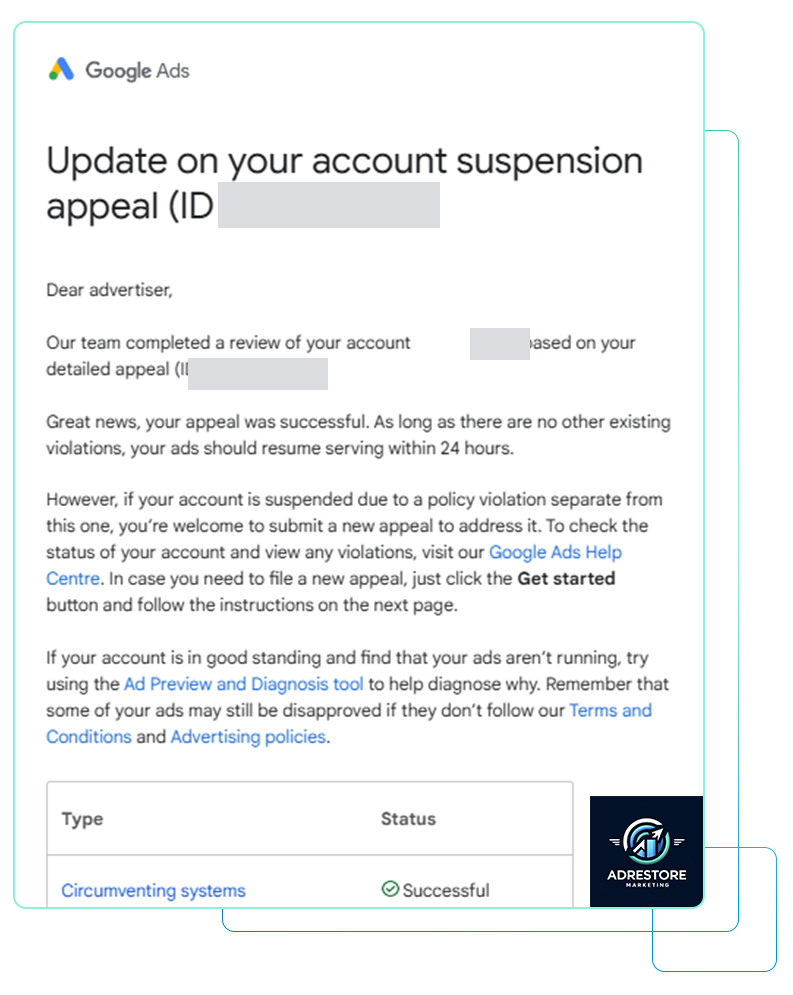
In the Circumventing Systems appeals we have handled, a decision has usually come back within five business days, and occasionally within a day. The spread depends on who looks at it. Google says it uses a combination of Google’s AI and human evaluation to enforce its policies, and in our experience an appeal picked up by automated review can come back quickly, while one routed to a person takes longer. The appeal form Google gives you for the suspension affects this as well. There is more on timings in how long a Google Ads reinstatement takes.
Whichever route it takes, Google’s bar doesn’t move: accounts are only reinstated in compelling circumstances, which is why the evidence has to be complete the first time.
Circumventing Systems is one of the three suspension types we handle most, and we have helped dozens of advertisers through it, most of them reinstated. Some of them describe the experience on our testimonials page.
If your notice says cloaking, book a free consultation before you change anything or file an appeal, particularly if several domains, sites or businesses sit behind the same account. Our Circumventing Systems appeal service covers diagnosis, fix and appeal end to end. For the policy as a whole, read our Circumventing Systems policy guide; for the other routes into it, see evasive ad content and advertiser verification.

Choose what we may use in this browser. You can come back and change this at any time. Privacy and cookie details
Your browser sent a Global Privacy Control signal, so analytics and advertising are off unless you turn them on here.
Keeps the site working, remembers your cookie choices and protects against automated traffic. Always on.
Helps us understand how visitors use the site and which pages and campaigns work: Clicky (no cookies, anonymised IP address) and Google Analytics.
Lets Google measure whether visits from our adverts lead to enquiries or bookings. No advertising audiences or personalised ads are built from this site.
Your choice is kept for 6 months in this browser. Change it any time via "Cookie settings" at the bottom of every page.